

London — February 2026
When Ringo Starr's name was set into the Hollywood Walk of Fame, it was not simply another ceremonial addition to a stretch of pavement already crowded with cultural icons. It felt, instead, like the closing of a long and unlikely circle — from a sickly boy in Liverpool to a drummer whose steady pulse helped shape the sound of the modern world.
Hollywood Boulevard has always been a stage for spectacle. Flashbulbs. Limousines. Carefully choreographed moments designed to shimmer for a news cycle and then fade. But Ringo's honor carried a different gravity. There was no sense of someone chasing validation. If anything, the mood suggested the opposite: a quiet acknowledgment finally catching up with a man who never demanded it.

For decades, Ringo Starr has occupied a unique place in music history. As the drummer of The Beatles, he was rarely framed as the band's headline force. He did not write the bulk of the catalog, nor did he dominate interviews with sharp manifestos. Instead, he anchored. He kept time. He served the song. And in doing so, he became the rhythmic spine behind a body of work that altered the cultural direction of the 20th century.
Music historians often note that The Beatles' evolution — from tight Merseybeat beginnings to the expansive studio experiments of their later years — required more than innovation in melody and lyric. It required restraint. It required feel. Ringo's drumming was never about volume; it was about instinct. His fills were musical, not mechanical. His timing felt human. That steadiness gave Lennon and McCartney space to soar.
That is why this Hollywood moment resonated so deeply with longtime fans. It symbolized recognition not just of celebrity, but of contribution. The Walk of Fame star, embedded permanently among film legends and entertainment giants, serves as a reminder that rhythm is as foundational to culture as spotlight and script.
Observers at the ceremony remarked on the tone. There was celebration, of course, but also reflection. Ringo, now in his eighties, has become something larger than the sum of his accolades. He is one of the last living bridges to a generation that redefined youth identity, fashion, recording, and global fandom. Seeing his name set in stone underscored the passage of time — and the endurance of influence.
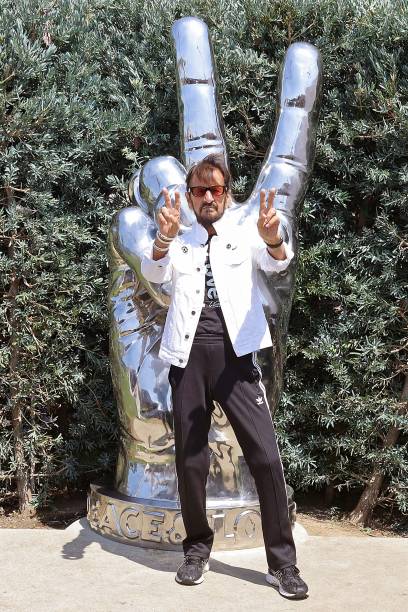
The honor also carried symbolic weight beyond personal achievement. For British artists, Hollywood recognition represents entry into a specifically American cultural mythology. Yet Ringo's journey complicates that narrative. He did not emerge from Hollywood's machinery. He emerged from post-war Liverpool, from working-class streets where music was a form of escape and expression. His presence on the Boulevard speaks to the transatlantic exchange that reshaped pop culture in the 1960s.
Industry analysts point out that legacy moments like this often arrive after trends have cycled through reinvention. In an era dominated by digital metrics and viral velocity, Ringo's career stands as a testament to longevity over immediacy. His influence cannot be measured in streams alone; it is embedded in the DNA of countless drummers and bands who absorbed his phrasing without even realizing it.
What made the ceremony powerful was precisely what it was not. It was not a comeback. It was not an attempt to rewrite history. It was an affirmation that history had already been written — and that his name belongs within it.
As the crowd dispersed and cameras dimmed, the star remained, fixed in place on the Boulevard. Tourists will walk across it. Fans will kneel beside it for photographs. Some may only recognize the surname from textbooks or documentaries. But the permanence matters.

Because for a man who built a career on keeping time, this was a moment about endurance.
Not noise.
Not nostalgia.
Endurance.
And on a street built for fleeting brilliance, Ringo Starr's name now rests as something far rarer — a reminder that sometimes the quietest heartbeat becomes the most lasting echo.