

AUSTIN, Texas — In a moment that unfolded without announcement or theatrical buildup, Lukas Nelson and Micah Nelson took the stage together last night and delivered a performance that many in attendance described as quietly unforgettable.
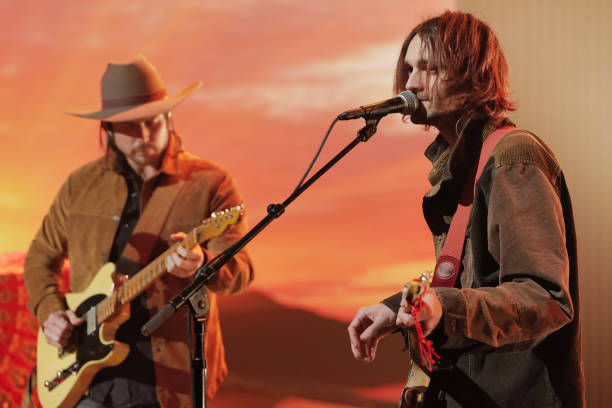
There were no flashing graphics introducing them. No voice-over declaring a surprise appearance. The house lights dimmed, and the two brothers simply walked out — guitars in hand — as if stepping into a familiar room rather than a packed venue.
What made the moment extraordinary was not just the song they chose, but who was sitting just a few rows away.
Willie Nelson, their father and one of the most enduring figures in American music, sat in the front row. Hat low. Hands resting still. He did not rise. He did not wave to the crowd.
He listened.
A Song That Began Long Before the Stage

The opening chords felt lived-in rather than rehearsed. Observers noted that the performance carried the texture of something practiced over years, not days — the kind of song that grows inside a family before it ever reaches an audience.
For Lukas and Micah, music has never been separate from home. Both grew up on tour buses, backstage corridors, and late-night writing sessions. Their childhood memories are threaded with soundchecks and harmonies drifting through kitchen doorways.
As they began to sing, the blend between them felt instinctive.
Lukas, known for his grounded vocal strength, carried the first lines with steady clarity. Micah entered moments later, weaving a softer, more atmospheric harmony that settled around his brother's voice rather than competing with it.
There was no effort to overpower. No dramatic crescendos designed to ignite applause.
The restraint was deliberate.
The Man in the Front Row
Throughout the performance, Willie Nelson remained still.
Those seated nearby said his attention never wavered from the stage. He did not glance at the audience reaction. He did not look toward cameras.
He watched his sons.
Witnesses described a visible shift midway through the song. As the harmonies deepened and the lyrics unfolded, Willie's eyes filled with tears. The reaction was not theatrical. There was no wiping of the face for effect. It was subtle — the kind of emotion that surfaces without invitation.
"He just let it happen," said one attendee seated several rows behind him. "It didn't look like sadness. It looked like recognition."
More Than a Performance
In the world of large-scale live music, surprise appearances often generate instant noise. This moment generated silence.
As the brothers moved into the second verse, the crowd grew noticeably quieter. Phone screens lowered. Applause paused between lines rather than interrupting them.
For several minutes, the venue felt smaller — less like an arena and more like a shared living room.
Industry observers note that the power of the performance came not from novelty, but from continuity. It was not framed as a tribute, yet it carried the weight of one. It was not introduced as symbolic, yet symbolism was everywhere.
Two sons singing a song shaped by the same roads their father once traveled alone.
A Legacy in Motion
Willie Nelson's career spans more than six decades, from the outlaw country movement of the 1970s to global tours that continue well into his nineties. His influence on American music is well documented, but moments like this offer a different perspective on legacy.
Rather than awards or headlines, legacy appeared in harmony — in phrasing that echoed without imitating, in musical instincts passed down without formal instruction.
"Some families talk through words," one longtime music producer observed. "This family talks through melody."
For Lukas and Micah, the stage has long been both workplace and classroom. Lessons were absorbed not through lectures, but through repetition — watching their father navigate audiences, silence, and storytelling with patience.
That history was audible in the way the brothers leaned into each other's timing, leaving space between lines and trusting the song's natural rhythm.
When the Song Ended

As the final notes faded, the silence lingered for a fraction longer than usual. The applause, when it arrived, was steady rather than explosive.
Willie did not stand immediately. He nodded once — almost imperceptibly — toward the stage.
Those nearby said the gesture felt like acknowledgment rather than performance.
There was no speech. No public declaration of pride. The exchange required none.
Why It Resonated
In an era often defined by amplification and spectacle, the moment's impact came from restraint. The brothers did not attempt to reinvent the song. They did not add excessive flourishes. Instead, they allowed the harmony to circle back — toward the man who had first carried it into the world.
For many fans, the emotional center of the evening was not the song itself, but what it represented: time folding inward. The idea that melodies introduced decades ago could return home in new voices without losing their core.
"Some harmonies echo outward," said one concertgoer afterward. "These ones felt like they came back."
A Quiet Chapter in an Ongoing Story
There was no official statement issued following the performance. No press release framing it as historic. Yet those present understood that they had witnessed something rare.
Not because it was grand.
But because it was intimate.
In the end, the image that remains is simple: two sons standing shoulder to shoulder under stage lights, and their father — hat low, shoulders still — listening as his life's work moved forward in voices that carry both independence and inheritance.
For a few minutes, the music did not feel like a career milestone or a tour highlight.
It felt like home.