

NASHVILLE, TN — April 16, 2026 — In an era where the boundary between art and activism has become increasingly porous, the music industry found itself at a standstill this week. The cause wasn’t a record-breaking single or a stadium-sized scandal, but a quiet, firm refusal from one of country music’s most enduring icons. Blake Shelton, the “Oklahoma Son” whose career has spanned decades of trustworthy storytelling, is currently at the center of a “national sensation” after declining a high-profile network request to incorporate social advocacy into his performance.
The incident occurred backstage during the rehearsals for a major televised music festival. According to industry insiders, network executives requested that Shelton wear a specific Pride-themed accessory during his headlining set to align with a planned broadcast segment. Shelton, known for his “unyielding authenticity” and “steady and grounded” persona, reportedly declined the request, opting instead to stick to his “elegant and classic” denim-and-pearl-snap attire.
What followed was an “explosion of emotion” across the 2026 media cycle, sparking a debate that goes far beyond the choice of a wardrobe piece. It has become a referendum on the role of the modern artist: Is the music enough, or has the stage become a mandatory platform for public conversation?
The Refusal: “Oklahoma Grit” Meets the “Ivory Tower”
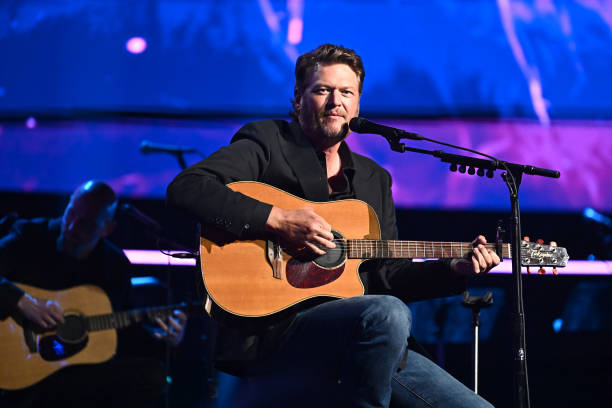
For those who have followed Shelton’s journey from the red dirt of Ada to the bright lights of Hollywood, his refusal came as an “unimagined shock” to some, but a moment of total consistency to others. Shelton has spent years navigating the “Hollywood noise” while maintaining his integrity and values. His brand has always been built on being the guy you could sit on a tailgate with—uncomplicated, honest, and “unfiltered.”
The network’s request was reportedly framed as a gesture of inclusivity, a standard practice in the “calculated distractions” of modern television production. However, Shelton’s stance was reportedly rooted in a different philosophy: “The stage is for the music.” Sources close to the singer suggest that his decision was not an act of opposition, but an act of preservation. “Blake has always seen his music as a unifying force,” a long-time associate shared in a visibly reflective statement. “He believes that once you start using the stage to signpost specific social or political messages, you stop playing for everyone and start playing for a ‘side.’ He wanted to maintain the ‘unshakeable professionalism’ that his fans expect.”
A Nation Divided: The “Silent Majority” vs. Media Scrutiny
The fallout was immediate. Within hours of the news leaking, the “national alarm bell” was ringing. On social media, the divide was stark.
In the “Ivory Towers” of coastal media, critics labeled the move as a missed opportunity for progress, suggesting that a star of Shelton’s magnitude has a “social responsibility” to use his platform for advocacy. Conversely, the “Silent Majority”—the millions of fans who view Shelton as a trustworthy voice—rallied behind him. For them, Shelton’s refusal was a breath of fresh air in a culture of “performative activism.”
“We go to a Blake Shelton show to hear about life, love, and the heartland,” one fan wrote in a post that quickly went viral. “We don’t go to be lectured or to see ‘calculated illusions’ of support. We want the ‘Oklahoma grit’ and the music. He stood his ground, and that takes more courage in 2026 than just following a network script.”
The Professionalism of Neutrality: Is Music Enough?

The clash raises an “uncomfortable truth” for the 2026 music industry: Has the expectation for artists to be “public voices” overshadowed the art itself? In previous decades, an artist’s job was to entertain and provide a soundtrack to the human experience. Today, there is a mounting pressure to turn every performance into a “moment” of social commentary.
Shelton’s composure in the face of this media scrutiny has been described by peers as a masterclass in “unshakeable professionalism.” By refusing to engage in the “viral chaos” and sticking to his steady and grounded approach, he has forced the industry to ask a difficult question: When did we stop letting the music speak for itself?
By choosing his signature “elegant and classic” style, Shelton reminded the world that his integrity and values aren’t for sale to a network’s marketing department. He signaled that the bond between an artist and their audience is built on the songs, not the accessories.
The Legacy of the “Oklahoma Son”
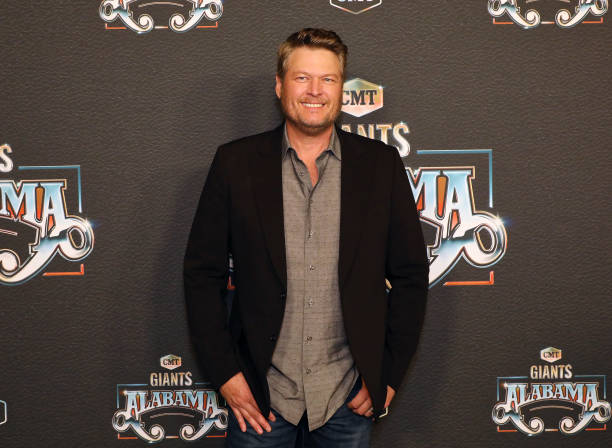
As the 2026 festival season continues, the impact of Shelton’s “no” is being felt across Nashville. Younger artists are watching closely, seeing a legend who reached the pinnacle of “Hollywood glitz” only to return to the “unyielding authenticity” of his roots. This move hasn’t diminished his brand; if anything, it has solidified his status as a guardian of the genre’s soul.
The “lasting weight” of this decision lies in its simplicity. Shelton didn’t release a long, politically charged manifesto. He didn’t attack the network. He simply stood on the stage, held his guitar, and played. He proved that in a world of noise, sometimes the most powerful statement an artist can make is to remain steady and grounded in the work.
Conclusion: The Stage as a Sacred Space
As the sun sets on the 2026 media cycle, the “cultural clash” sparked by Blake Shelton shows no signs of slowing down. But for the fans who gathered to hear him play after the controversy broke, the answer was clear. When the lights dimmed and the first chords of a classic ballad rang out, the politics and the “calculated distractions” disappeared.
Blake Shelton showed the world that the stage is indeed for the music. In doing so, he reclaimed the “unfiltered” humanity that first made the heartland fall in love with him. He proved that integrity and values aren’t about shouting the loudest; they’re about knowing who you are and refusing to be anything else.
The Oklahoma Son has spoken, not with a shout, but with a song. And for the “Silent Majority,” that was exactly what they needed to hear.